
Eastern Strings
Musiqa min Al Dunia As-Sharqia ~ Music from the Eastern World
Original Microtonal Music Inspired by Traditional Arabic Maqamat and Iqaat and Other World Music Traditions
by
California Multi-Instrumentalist
Nathan Craver
| About | ~ | ~ | Performances | ~ | Recordings |
Egyptian Oud
Purchased 2006
From Gawharet El Fan, Cairo, Egypt
www.gawhara.com.eg

|
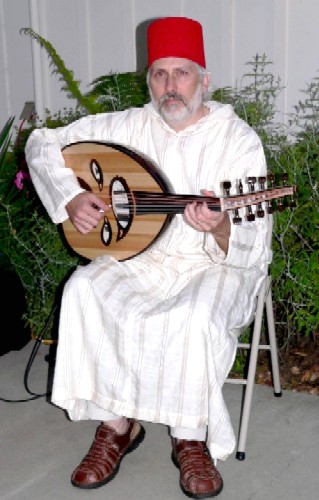
The English word lute, which derives from the Spanish laud, originally came from the Arabic al-'ud, literally meaning 'branch of wood.' Between the eighth and tenth centuries, the 'ud had only four strings; a fifth was added in the eleventh century by Zeryab, who was originally from Persia and brought many innovations to the Andalusian courts of southern Spain, and a sixth later on in the fifteenth century. Shaped like half a pear with a short fretless neck, the 'ud has five or six pairs (or 'courses') of strings played with a plectrum (called a 'risha') - originally a trimmed eagle's feather, but now normally made of horn or plastic - producing a deep and mellow sound. Like a violin, the fretless neck of the oud allows the player to produce a very expressive tone and to play any of the notes in the quartertone Arabic scales (or maqams). Virtuosos across the Middle East refer to it as 'the King of all instruments.' I became aware of the oud early on, after hearing the music of multi-instrumentalists Sandy Bull, Davy Graham and David Lindley. I was reintroduced to the instrument upon seeing Hamza El Din open a couple of Grateful Dead shows, but it would be many years before I attempted to play one (and even then, I found it so uncomfortable to hold that I decided it wasn't for me). When my wife started belly-dancing, I took up Middle-Eastern drumming and studied with some of the best in the area - but for some reason, they all suggested that I take up the oud! Eventually, the opportunity to buy one came up and I thought I'd give it another try. I bought this one on our trip to Egypt in 2006 and put a Najarian pickup on it. This instrument came strung in the traditional Egyptian way, with five courses. When I changed the strings, I decided to try adding a high 'f' pair as a sixth course and I really like the present tuning of FAADDggccff (low to high). For further information about the oud, see Mike's Oud Site. |
 |
 |
 |
Recordings:
Sharia M. Ali (MP3, 1.9MB, 3:11)
Improvised over frame drums after I brought this instrument back from Cairo, November 2006
Andah Aleik (Mohammed Abdel Wahab) (MP3, 10.3MB, 7:31)
Al 'Azifoon Home Recording, Dec. 2008, with Paul and Zaid on percussion
